
Melody vs Harmony Explained (Music Theory Basics)
675 views
A melody can sound perfectly fine by itself. Then you add one chord, and suddenly the same three or four notes feel sad, bright, tense, romantic, unresolved—or completely wrong.
That little moment is where melody and harmony stop being abstract music-theory terms and start becoming useful.
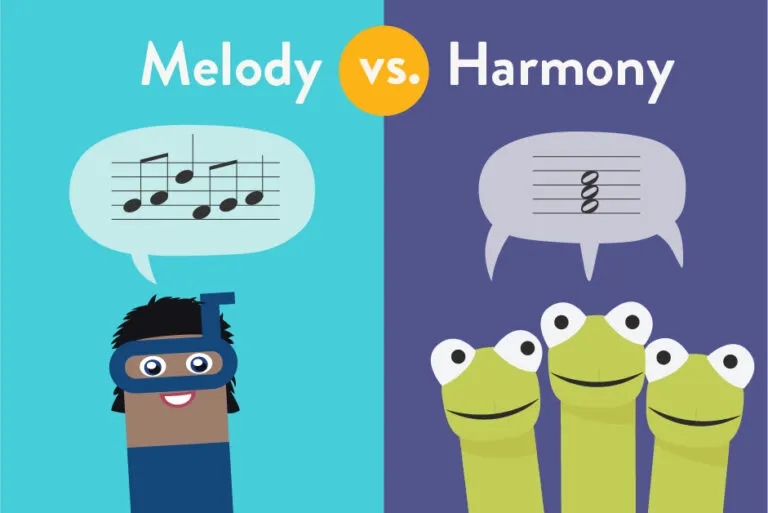
There’s a reason this distinction matters so much for singers, instrumentalists, songwriters, beatmakers, and producers. Melody gives you the musical line you can follow. Harmony changes the meaning of that line by placing other pitches around it. The two aren't competing ingredients. They constantly reshape each other.
And there’s a wrinkle beginners often miss: melody isn't simply “notes played one after another,” and harmony isn't simply “notes played at the same time.” Those descriptions are useful starting points, but real music gets more interesting very quickly.
Melody is the line your ear follows
If you hum the vocal hook after a song ends, you're probably humming its melody.
Technically, melody is an organized succession of pitches unfolding through time. Rhythm matters too. So do contour, register, range, repetition, and phrasing. A melody can climb, fall, hover around one pitch, leap dramatically, or repeat a tiny motif until it becomes unforgettable.
A useful way to hear melody is to strip everything else away.
Imagine a singer performing a verse with no guitar, bass, drums, or backing vocals. The song hasn't disappeared. You still have a musical idea. That's melody in its most exposed form.
Music-theory education commonly treats features such as contour, register, range, intervals, and rhythmic organization as core parts of melodic understanding. The College Board's AP Music Theory framework, for example, explicitly includes melodic contour, register, and range alongside rhythm and pitch-related concepts.
Try this on your own
Take a familiar song and sing only the vocal line.
Don't worry about lyrics.
Now ask:
Does the line mostly move by step or leap?
Where does it reach its highest note?
Which note sounds like “home”?
Where does the phrase seem to pause?
Which little rhythm keeps coming back?
Those questions reveal more about melody than simply knowing the notes' names.
A memorable melody is usually a pattern with direction, not a random collection of pitches.
That distinction becomes especially useful when you're writing your own material. A MIDI clip containing eight notes isn't automatically a melody. It needs some sense of identity and musical organization.
Harmony is the world underneath—and around—the melody
Harmony concerns the relationships among pitches, especially pitches sounding together and the progression of chords over time.
A C major chord contains C, E, and G. An F major chord contains F, A, and C. Put those chords underneath a melody and you've created a harmonic environment.
The environment matters.
Suppose your melody lands on the note E. Over C major, E is the third of the chord and sounds stable. Put that same E over F major and it becomes the major third of F. Put it over A minor and it becomes the fifth. Put it over an E7 chord and it can become the root.
Same melody note. Different harmonic meaning.
That is one of the most practical ideas in beginner music theory.
Harmony isn't limited to block chords, either. Counterpoint can create harmony through multiple independent lines. A choir can produce harmony without anyone explicitly thinking, “I'm playing a chord.” A bass line can strongly imply a harmonic progression even when a keyboard isn't playing full triads.
MIT's Harmony and Counterpoint curriculum treats melody, harmony, counterpoint, and form as interconnected parts of musical practice rather than isolated boxes. Its coursework combines analysis, composition, sight-singing, and keyboard work for exactly this reason.
Melody vs harmony: the fastest way to tell them apart
Here's the beginner-friendly version:
Melody | Harmony |
|---|---|
A musical line | The pitch relationships surrounding that line |
Usually heard as a sequence | Often heard as simultaneous pitches and chord movement |
Frequently carries the hook | Often supplies color, stability, tension, and support |
Can work alone | Can exist without a prominent melody, too |
Think “what can I sing?” | Think “what chords or voices are happening underneath?” |
The important word is usually.
A piano player can make harmony highly melodic. A bass line can become the most memorable part of a track. A backing vocal can sound like a second melody rather than simple chord support.
Music doesn't care about our neat categories.
The same melody can change completely
Here's a simple experiment.
Write this four-note melody in C major:
E – G – F – E
Play it over:
C – F – G – C
Now change the chords:
Am – F – G – Am
The notes haven't changed.
Your perception has.
Under the first progression, the melody can sound relatively bright and settled. Under the second, the same pitches can take on a darker or more reflective character because their relationship to the changing chords has shifted.
This is why experienced songwriters don't always ask, “What chord fits this melody?”
They also ask:
“What does this chord make the melody mean?”
That's a much more powerful question.
Chords don't just support melody—they can fight it
Beginners sometimes assume the harmony's job is to make every melody note fit perfectly inside the chord.
Not necessarily.
A melody can use passing tones, neighbor tones, suspensions, anticipations, chromatic notes, and other non-chord tones. A note can sound tense precisely because it doesn't belong comfortably to the underlying chord.
Take a C major chord: C–E–G.
If the melody plays D over that chord, D isn't a chord tone. Yet it may sound completely natural if it moves to E. The tension is temporary.
This relationship between stable and unstable notes is one reason melody and harmony feel like motion rather than a stack of disconnected sounds.
Traditional tonal theory goes much deeper here. College-level theory curricula commonly study chord function, cadence, voice leading, embellishing tones, melodic motives, and harmonic progression as interacting systems.
Harmony has a direction, not just a color
Another common beginner mistake is treating chords as isolated emotional labels:
C major = happy
A minor = sad
That shortcut is catchy. It's also unreliable.
Harmony is partly about function and expectation.
In a C-major context, C major can feel like a tonic, or point of rest. G major or G7 often creates dominant tension that strongly points back toward C. F major can function as a predominant area leading toward the dominant.
So this progression:
C → F → G → C
isn't merely four colors in sequence.
It creates a journey.
The listener hears departure, increasing tension, and return. That's one reason functional harmony became such an important part of Western tonal theory. Berklee's tonal-harmony curriculum specifically connects harmonic and melodic practices with formal structure, composition, arranging, and contemporary popular music.
What happens when two melodies play together?
This is where the melody-versus-harmony distinction gets more interesting.
Imagine two singers:
Singer 1: C – D – E – G
Singer 2: E – F – G – B
Neither singer is simply “the harmony” in the basic chordal sense. Each has a line.
Together, their simultaneous notes create harmonic relationships.
That's counterpoint: independent melodic lines interacting with one another.
In a dense vocal arrangement, you might have a lead melody plus a third above it, a sixth below it, occasional contrary motion, and a bass line doing something completely different. The resulting harmony isn't merely “the chords.” It's the sum of those moving relationships.
This is why saying “melody is horizontal and harmony is vertical” is helpful—but incomplete.
Music moves horizontally and vertically at once.
A practical producer's test
Open your DAW and create a four-bar MIDI melody.
Don't add drums yet.
Duplicate the melody to a second instrument, then experiment with chords underneath it.
Try this workflow:
Write the melody first. Keep it short—four or eight bars is plenty.
Find the likely key. Identify the notes that feel stable and the pitch that sounds like home.
Try three different chord progressions. Don't settle for the first one that technically works.
Listen to the melody's important notes. Check whether they're chord tones, tensions, or passing tones.
Change the bass before changing the melody. A different bass note can completely alter the perceived harmony.
Only then arrange the texture. Add pads, guitar, piano, strings, or backing vocals after the harmonic relationship works.
That last step saves time.
I've seen plenty of otherwise promising productions get buried under layers of pads and synths because the underlying chord progression never actually made the melody better.
More plugins won't fix that.
Modern DAWs make the experiment easy
Ableton Live 12 includes MIDI transformation tools and a MIDI Chord effect. The Chord device can add up to six additional pitches to an incoming MIDI note, with shifts ranging from -36 to +36 semitones. That makes it easy to hear how a single melodic trigger can become a chordal texture.
Logic Pro also has a Chord Trigger MIDI plug-in. It can assign chords to individual MIDI keys, transpose memorized chords, and define a trigger range. Apple's documentation even describes using the setup so one hand can play a melody while the other triggers chords.
For notation work, MuseScore Studio supports chord symbols, Roman numeral analysis, and Nashville numbers. You can also realize chord symbols into actual notes, which is handy for hearing different voicings rather than staring at chord names on a page.
Melody, harmony, and the bass: the hidden third player
Here's an easy trap.
You write a melody. You choose a chord. Everything sounds acceptable.
Then you change the bass note.
Suddenly the whole progression sounds different.
That's because chord identity isn't only about the collection of pitches. Voicing, inversion, bass movement, register, and context all affect what the ear perceives.
C–E–G with C in the bass is a C-major triad in root position.
E–G–C with E in the bass is C major in first inversion.
The chord hasn't fundamentally changed its pitch collection. The bass has changed the balance and direction of the harmony.
In a pop production, that can be a huge deal. A bass line moving C–B–A–G under a sustained vocal note can create motion even when the singer barely moves.
That's why harmony shouldn't be reduced to “the piano chords.”
How to hear melody and harmony separately
Use headphones if you can.
Pick a song with a clear vocal and accompaniment. Listen once normally. Then listen again while concentrating only on the vocal contour. On the third pass, ignore the vocal and follow the bass.
That third listen is surprisingly revealing.
Bass movement often exposes the harmonic skeleton more clearly than the full chord voicing does.
You can also use software to remove or isolate parts, but don't become dependent on separation tools. Your ears need practice too. Ear training is part of formal theory study for a reason: understanding music on paper is useful, but hearing the relationship is the real skill. The Royal Conservatory's theory curriculum likewise integrates practical activities, guided listening, melody writing, harmony, and analysis rather than treating theory as purely written work.
Five questions beginners usually ask
Is melody more important than harmony?
Not inherently. A great melody can survive simple harmony, while sophisticated harmony can't rescue a weak musical idea forever. In many songs, the melody gets remembered first, but harmony determines much of its emotional and structural context.
Can a song have melody without harmony?
Absolutely. A solo voice, flute, or unaccompanied chant can carry a melody without chordal accompaniment. Many musical traditions also demonstrate that music doesn't require Western-style functional harmony to work.
Can harmony exist without melody?
Yes. A sequence of chords can function without a distinct lead melody. Ambient music, intros, interludes, and accompaniment-only passages do this constantly. The listener may still mentally invent a melodic center.
Is a chord the same thing as harmony?
No. A chord is a specific collection of pitches, such as C–E–G. Harmony is the broader system of relationships involving chords, simultaneous pitches, voice leading, progression, function, and context.
Should I write melody or chords first?
Either can work. If you're a beginner, try both approaches. Start with a melody when you have a strong hook in your head; start with chords when you already hear a groove, bass movement, or harmonic mood. Then reverse the process on your next song.
The useful takeaway: stop separating them
Melody and harmony are easier to understand once you stop treating them as two unrelated subjects.
A melody creates expectations. Harmony confirms, redirects, delays, or contradicts those expectations. A chord can make a familiar note feel stable—or suddenly make it ache for resolution. A bass note can turn an ordinary chord progression into something that sounds entirely new.
That interaction is the real lesson.
If you're practicing today, don't memorize another definition. Take an eight-bar melody you already know, change the chords underneath it, and listen carefully to what changes. Then keep the chords and rewrite the melody.
You'll hear music theory doing its job.
And once you can hear that relationship without thinking about the terminology, you're ready for the next step: analyzing chord functions, writing stronger bass lines, and deliberately using harmonic tension instead of stumbling into it.
melody vs harmony
music theory basics
melody explained
harmony explained
beginner music theory
Found this helpful? Share it!