
Time Signatures Explained: Rhythm Basics for Beginners
439 views
A drum loop can sound perfectly fine until you try to play a melody over it. Then something feels off. The notes land in the wrong places. The loop seems to restart before your phrase is finished. You count “1-2-3-4,” but the groove keeps pulling somewhere else.
Usually, the problem isn't your timing.
You may be hearing the meter incorrectly.
Time signatures are one of those music-theory topics that look almost insultingly simple on paper—two numbers stacked vertically—but they control how beats are grouped, where musical phrases feel settled, and how performers, songwriters, and DAWs organize rhythm.
Melody Beats already covers the basic definition of time signatures, so this guide takes a more practical route: how to hear, count, program, and actually use meter without getting trapped by the notation.
Start with the pulse, not the numbers
Before worrying about 4/4, 3/4, or 7/8, find the steady pulse.
Tap your foot.
That pulse is the recurring beat you can walk, clap, nod, or tap along with. Tempo determines how quickly it happens; meter determines how those beats are organized into repeating groups.
That's the distinction beginners often miss.
At 100 BPM, four quarter-note beats in 4/4 still occupy one bar. At 60 BPM, the bar simply takes longer. Tempo changes speed; the time signature describes the rhythmic framework.
A bar, or measure, is the repeating container. Bar lines divide written music into those containers.
The numbers then tell you how the container is organized.
The top number
The top number tells you how many units appear in the measure.
So:
2/4 = two quarter-note beats
3/4 = three quarter-note beats
4/4 = four quarter-note beats
6/8 = six eighth-note units
But there's a catch.
The top number doesn't automatically tell you how the music feels.
A 6/8 bar contains six eighth notes, yet musicians commonly feel those six notes as two larger beats, each divided into three. Yamaha describes 6/8 this way as a two-part grouping rather than simply six equally important pulses.
That grouping is where meter starts becoming something you can hear rather than merely calculate.
The bottom number is a note value—not “the speed”
The bottom number tells you which note value is being used as the written beat unit.
The common ones are:
Time signature | Basic reading | Typical feel |
|---|---|---|
2/4 | 2 quarter-note beats | Marching, direct |
3/4 | 3 quarter-note beats | Waltz-like |
4/4 | 4 quarter-note beats | Straight, familiar |
6/8 | 6 eighth-note units | Two groups of three |
9/8 | 9 eighth-note units | Three groups of three |
12/8 | 12 eighth-note units | Four groups of three |
This is why treating the denominator as “how fast the song goes” causes trouble.
It doesn't.
A 6/8 song can be slow. A 6/8 song can be blisteringly fast. Tempo and meter are separate decisions.
4/4 is common—but don't let it become a cage
Most popular music uses 4/4, and there’s a good reason. Four beats create an extremely flexible framework for drums, bass lines, vocal phrases, chord changes, and repeated song sections. Berklee identifies 4/4 as the common meter of much popular and jazz music.
Try counting:
1 – 2 – 3 – 4
Now put a kick drum on every number.
You have the skeleton of a basic four-on-the-floor groove.
Add a snare on beats 2 and 4. Suddenly the meter becomes much easier to feel. The notation hasn't changed, but the accents have made the hierarchy obvious.
That's meter in action.
A common beginner mistake is assuming every beat has equal weight. They don't. Beat 1 generally feels strongest, while beats 2 and 4 can become especially important in pop, rock, funk, and dance music.
The groove comes from that hierarchy.
Not just the counting.
3/4 changes the shape of a phrase
Now count:
1 – 2 – 3 | 1 – 2 – 3
The loop closes sooner.
That's the characteristic sensation of 3/4.
Waltzes are the obvious example, but don't reduce 3/4 to “the waltz time signature.” Songwriters can use it for ballads, folk music, instrumental passages, and deliberately unsettled sections.
Try accenting beat 1:
ONE – two – three | ONE – two – three
Then play a simple chord on each beat.
The difference from 4/4 becomes obvious almost immediately.
Your musical phrase has acquired a different stride.
6/8 is where beginners often get fooled
This is the big one.
A beginner sees 6/8 and thinks:
1 – 2 – 3 – 4 – 5 – 6
Technically, those six eighth-note subdivisions exist. Musically, that's often not the best way to feel the bar.
Try:
ONE-two-three FOUR-five-six
Now you've got two main pulses.
That distinction is the practical heart of compound meter. In compound time, each main beat naturally divides into three smaller parts. Common examples include 6/8, 9/8, and 12/8.
Here's a useful experiment.
Set a metronome around 70 BPM. Treat each click as one large beat of 6/8. Say:
ONE-and-a TWO-and-a
Then subdivide:
ONE-and-a TWO-and-a
Your body starts to understand the meter before your brain has to label it.
That's much more useful than memorizing a definition.
Simple and compound meter: the shortcut that actually works
The terminology can sound academic, but the underlying idea is straightforward.
In simple meter, the main beat naturally divides into two:
2/4
3/4
4/4
In compound meter, the main beat naturally divides into three:
6/8
9/8
12/8
This doesn't mean every rhythm inside those signatures must obey the division rigidly. Syncopation, rests, ties, and accents can obscure the underlying pulse.
That's the point.
A good rhythmic player can hear the grid even when the notes deliberately avoid it.
Odd meters become easier when you stop counting every number
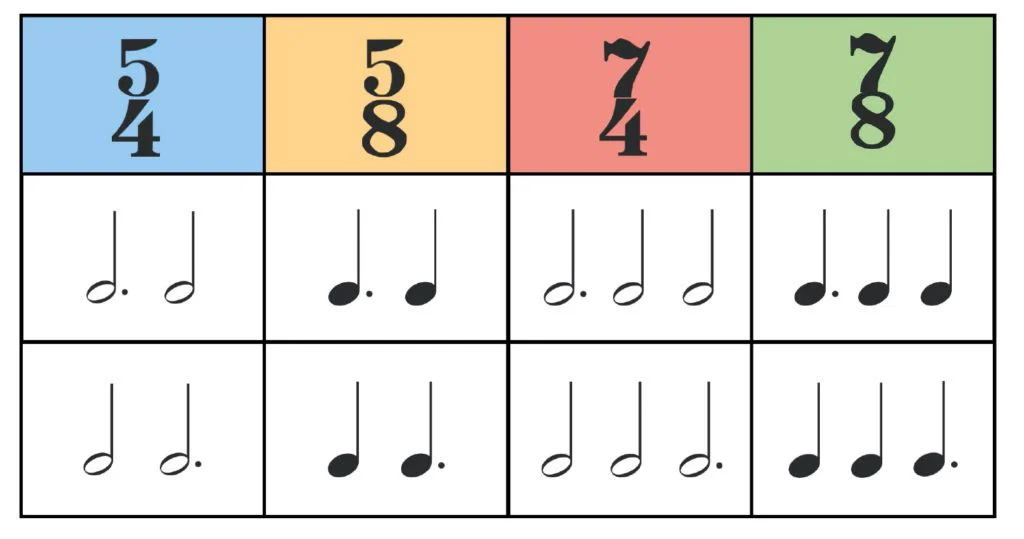
Now for 5/4 and 7/8.
Don't panic.
The trick is grouping.
A 5/4 bar might be organized as:
1-2 | 1-2-3
or:
1-2-3 | 1-2
Both contain five quarter-note beats. They don't feel identical.
The same idea works with 7/8:
2 + 2 + 3
Count:
ONE-two ONE-two ONE-two-three
Suddenly 7/8 stops sounding like an arbitrary mathematical problem.
It becomes a sequence of familiar little groups.
This approach is common in serious rhythm training. Berklee's rhythm teaching explicitly works with binary and ternary structures and uses conducting, counting, and identifying downbeats as practical ways to internalize meter.
Try this five-minute rhythm workout
You don't need an instrument.
Set a metronome to 80 BPM.
Clap four steady beats and count 1-2-3-4 for several bars.Keep the pulse, change the grouping.
Switch to 1-2-3, then return to four.Move into 6/8.
Feel two large pulses, each containing three subdivisions: ONE-and-a TWO-and-a.Try 5/4.
Alternate between 2+3 and 3+2. Notice how the accent pattern changes even though the bar length doesn't.
Don't speed up.
If your foot starts wandering, slow the metronome down. Yamaha recommends a similar progression for rhythm practice: establish quarter-note counting, then add eighth- and sixteenth-note subdivisions while keeping the underlying pulse steady.
Time signatures in a DAW aren't just decoration
This becomes especially relevant once you start producing music.
In Ableton Live 12, the project can use time-signature markers throughout the Arrangement, and the Control Bar lets you adjust numerator and denominator values. Live supports numerator values from 1 through 99 for these controls and denominators of 1, 2, 4, 8, or 16.
That flexibility matters.
Suppose your song begins in 4/4, shifts to 7/8 for a tense instrumental passage, then returns to 4/4. You don't have to force every section onto one grid. Add a time-signature change at the appropriate point.
There's an interesting edge case here, too: Ableton Live 12 allows time-signature markers to be placed at positions that can create a fragmentary bar. Live can leave those incomplete measures in place, or you can use its correction options to complete or remove the fragmentary duration.
That's exactly the sort of thing that can make a perfectly good musical idea look “wrong” inside a DAW.
And don't confuse clip time signature with the project's meter. In Live 12, a clip can have its own displayed time signature without changing playback; this is useful for organizing polymetric material.
GarageBand users should also be aware of the limitation that commonly frustrates beginners: Apple's current App Store listing includes user feedback requesting custom time signatures beyond the familiar 4/4, 3/4, and 6/8 options.
The practical lesson is simple: your notation grid is a tool, not the music itself.
How to identify a time signature by ear
You can train this.
Don't start by asking, “What time signature is this?”
Ask three smaller questions:
Where is the steady pulse?
Tap along until your tapping feels natural.
Where does the pattern reset?
Listen for the point where the rhythmic phrase feels like it returns home.
Which beats feel strongest?
Try grouping them.
If you hear:
ONE-two-three FOUR-five-six
you may be hearing 6/8.
If you hear:
ONE-two-three-four
with a strong return every four beats, 4/4 is a reasonable starting hypothesis.
Berklee's ear-training curriculum uses precisely this kind of process—demonstrating the beat, identifying the downbeat, counting, conducting, and recognizing time signatures in familiar music.
Don't worry about getting it right instantly.
Your ear gets better through repetition.
A few common mistakes worth avoiding
Mistake one: treating 6/8 as “six beats.”
Learn to hear its usual 3+3 grouping.
Mistake two: confusing tempo with time signature.
BPM tells you how quickly the pulse moves. Meter tells you how that pulse is organized.
Mistake three: assuming the time signature dictates the groove.
It provides the framework. Accents, syncopation, instrumentation, swing, articulation, and arrangement create the actual feel.
Mistake four: counting forever.
Counting is training wheels. The goal is eventually to feel the bar without mentally reciting every number.
Mistake five: forcing an odd-meter idea into 4/4 because the DAW grid looks familiar.
If the musical phrase naturally groups as 7/8, use 7/8. Your arrangement will often become easier to read—and easier to play.
FAQ
Is 4/4 the same as common time?
Yes. 4/4 is commonly called common time, and it can also be represented by the symbol C in traditional notation. It is especially widespread in popular and jazz music.
Is 6/8 faster than 3/4?
No. The time signature doesn't determine tempo. A 6/8 piece can be slower or faster than a piece in 3/4. The important difference is how the beats are grouped and subdivided.
Why does 6/8 sound different from 3/4?
Both can involve three-part motion, but their underlying beat organization differs. 3/4 normally has three main quarter-note beats; 6/8 is commonly felt as two main beats, each subdivided into three eighth notes.
What time signature should a beginner learn first?
Start with 4/4, then learn 3/4, 2/4, and 6/8. Once those feel comfortable, move into 5/4, 7/8, 9/8, and mixed-meter passages.
Can a song change time signature?
Absolutely. Time-signature changes are common in composition, film scoring, progressive music, jazz, and experimental production. Modern DAWs such as Ableton Live 12 can place meter changes directly in the arrangement.
The fastest way to make this stick
Don't memorize a chart and hope rhythm magically appears.
Put on a metronome.
Clap 4/4 until it feels boring. Then make it 3/4. Try 6/8 and feel the two large pulses. Finish with 5/4, grouping it 2+3.
Five minutes like that teaches more than rereading the definition ten times.
Once your foot can keep the pulse while your hands play a different subdivision, you're getting somewhere. That's the point where time signatures stop looking like fractions on a page and start behaving like musical architecture.
Next time a groove feels strangely “off,” don't immediately change the notes.
Stop. Find the pulse. Find the grouping. Then decide what meter you're actually hearing.
time signatures
rhythm basics
music theory for beginners
understanding rhythm
beginner music lessons
Found this helpful? Share it!