
Intervals in Music Theory: How to Measure the Distance Between Notes
509 views
You can know every note on the keyboard and still get stuck on one deceptively simple question: How far apart are these two notes?
C to E sounds familiar. C to F feels different. C to F♯ can sound tense, almost restless. Yet saying “they’re three, four, and six semitones apart” only tells part of the story.
Music theory gives that distance a name: an interval.
Intervals are the measuring system behind melodies, scales, chords, harmony, ear training, transposition, and much of the vocabulary musicians use when describing why two notes sound the way they do. The trick is that interval measurement has two layers: number and quality. Once those are separated, the subject gets considerably less mysterious.
What an interval actually measures
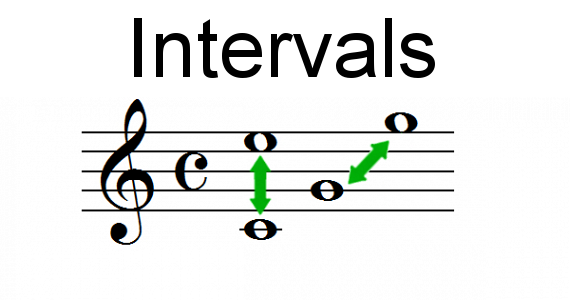
An interval is the distance between two pitches. Those pitches can be played one after another, creating a melodic interval, or at the same time, creating a harmonic interval.
Take C and E.
Count the letter names, including both endpoints:
C–D–E.
That's three letters, so the interval is a third.
Now compare C and G:
C–D–E–F–G.
Five letters. A fifth.
Simple so far.
But C–E and C–E♭ aren't the same interval. Both are thirds because the letter-name distance is still three, yet C–E is a major third while C–E♭ is a minor third.
That's the key distinction:
Number tells you how many letter names apart the notes are.
Quality tells you the precise size of that interval.
The Open University describes the same two-part approach: interval labels combine a number with a quality, rather than relying solely on semitone counting.
The seven basic interval numbers
The standard interval numbers run from unison through octave:
Interval | Example from C | Semitones |
|---|---|---|
Unison (1st) | C–C | 0 |
Second (2nd) | C–D | 2 |
Third (3rd) | C–E | 4 |
Fourth (4th) | C–F | 5 |
Fifth (5th) | C–G | 7 |
Sixth (6th) | C–A | 9 |
Seventh (7th) | C–B | 11 |
Octave (8th) | C–C | 12 |
The semitone values in this table describe the familiar diatonic forms, not every possible spelling of an interval.
That's where interval quality enters.
A C–F♯ and a C–G♭ are both six semitones apart on a piano, but they aren't spelled the same way theoretically. C–F♯ is an augmented fourth; C–G♭ is a diminished fifth. They are enharmonic in equal temperament, yet their interval identities can behave differently in notation and harmonic analysis.
Major, minor, perfect: the quality system
There are five standard quality labels:
Perfect, major, minor, augmented, and diminished.
Not every interval can use every label.
Unisons, fourths, fifths, and octaves belong to the perfect family. Seconds, thirds, sixths, and sevenths belong to the major/minor family.
So these are valid:
Perfect 4th
Perfect 5th
Major 3rd
Minor 3rd
Major 7th
Minor 7th
But “major fifth” isn't standard interval terminology. Nor is “minor fourth.”
That little rule eliminates a surprising number of beginner mistakes.
A useful semitone reference
For intervals up to an octave, memorize this map:
Semitones | Interval |
0 | Perfect unison |
1 | Minor 2nd |
2 | Major 2nd |
3 | Minor 3rd |
4 | Major 3rd |
5 | Perfect 4th |
6 | Tritone |
7 | Perfect 5th |
8 | Minor 6th |
9 | Major 6th |
10 | Minor 7th |
11 | Major 7th |
12 | Perfect octave |
A tritone at six semitones can be spelled as an augmented fourth or diminished fifth. The two spellings are enharmonic but not theoretically interchangeable in every context.
The fastest way to identify an interval
If you're staring at sheet music, don't immediately start counting semitones.
There's a better two-stage method.
Step 1: Count the letter names
Suppose the notes are F and D.
F–G–A–B–C–D.
That's six letters, so you've got a sixth.
Now determine its quality.
If the notes are F and D, the interval is a major sixth, because D occurs in the F major scale.
If the upper note changes to D♭, the result becomes a minor sixth.
This major-scale method is a standard approach taught in foundational interval theory: treat the lower note as the tonic, identify the interval within its major scale, then account for accidentals.
Step 2: Check the semitone distance
For quick verification, count the half steps.
C to E = 4 semitones → major third.
C to E♭ = 3 semitones → minor third.
C to F = 5 semitones → perfect fourth.
C to F♯ = 6 semitones → augmented fourth.
This is especially handy at the keyboard. Your fingers don't care what the interval is called; the keys give you a physical way to verify the distance.
Why semitone counting isn't enough
Here's the trap.
C–F♯ and C–G♭ occupy the same number of semitones in 12-tone equal temperament. If you're using a piano or MIDI keyboard, they normally produce the same sounding pitch.
Yet music notation calls them different intervals.
Why?
Because spelling communicates musical function.
Imagine a chord containing C, E, and G♯. Calling G♯ “A♭” isn't merely a cosmetic change. The spelling affects how the note relates to the surrounding harmony and how a performer reads the musical line.
The same issue appears in scales, chord extensions, voice leading, and written analysis. Semitone distance is powerful, but interval number preserves information that raw pitch distance loses.
Sound tells you one thing. Spelling tells you another.
Good theory keeps both.
Perfect intervals have an unusual rule
The perfect family deserves special attention because it doesn't follow the major/minor pattern.
The perfect intervals are:
Perfect unison
Perfect fourth
Perfect fifth
Perfect octave
Lower a perfect interval by one semitone and it becomes diminished.
Raise it by one semitone and it becomes augmented.
So:
F–B♭ = perfect fourth
F–B = augmented fourth
F–B𝄫 = diminished fourth
The major/minor family behaves differently:
Major 3rd → lower one semitone → minor 3rd
Minor 3rd → lower another semitone → diminished 3rd
Major 3rd → raise one semitone → augmented 3rd
That distinction is worth learning rather than trying to reason it out from scratch every time.
Interval inversion: the shortcut hiding in plain sight
An interval can be inverted by moving one note across the octave.
A major third becomes a minor sixth.
A minor third becomes a major sixth.
A perfect fourth becomes a perfect fifth.
A major second becomes a minor seventh.
There's a wonderfully compact pattern:
1 ↔ 8, 2 ↔ 7, 3 ↔ 6, 4 ↔ 5.
For quality:
major ↔ minor
perfect ↔ perfect
augmented ↔ diminished
The University of Puget Sound's Music Theory for the 21st-Century Classroom uses this same inversion framework, including the useful example that a minor sixth inverts to a major third.
This becomes especially useful when an interval below a note is awkward to calculate directly. Invert it, solve the easier interval above, then invert the answer back.
A small trick. A big time saver.
Intervals bigger than an octave
Once the distance exceeds an octave, musicians use compound intervals.
A ninth is essentially an octave plus a second.
A tenth is an octave plus a third.
An eleventh is an octave plus a fourth.
A twelfth is an octave plus a fifth.
So C up to D in the next octave is a major ninth, not merely “a second.”
This matters in chord symbols and arranging. A C–E span can be called a third, while C–E with the E an octave higher is a tenth. The underlying pitch relationship is related, but the written interval tells you about register and spacing.
Intervals in melody, chords, and ear training
Intervals aren't just an exam-room exercise.
A melody is, in effect, a chain of interval movements. Instead of memorizing isolated notes, you can start hearing the distance between successive pitches.
That's why interval ear training works.
Hear C rising to G? That's a perfect fifth.
Hear C rising to E? Major third.
Hear C rising to E♭? Minor third.
With practice, the sound itself begins to suggest the label before you consciously calculate it.
This is also where intervals become useful for musicians who don't read notation fluently. On a guitar, piano, MIDI controller, or singing exercise, you can train the ear and physical sense of distance together. The theoretical label then becomes a description of something you've already learned to hear.
A practical five-minute interval drill
Don't try to memorize everything in one sitting. That usually turns into a miserable flash-card session.
Try this instead:
Pick a starting note, such as C.
Play or sing a target note.
Name the interval before checking it.
Verify the letter-name number.
Count semitones as a final check.
Start with major/minor seconds and thirds. Then add fourths and fifths. Sixth and seventh intervals can come later.
For extra mileage, reverse the exercise: name an interval, then find it on the keyboard without looking at a chart.
That last step exposes weak spots quickly.
Common interval mistakes musicians make
A few errors appear again and again.
Calling every distance by its semitone count.
Six semitones is not always simply “a tritone” if you're analyzing notation. The spelling may specifically indicate an augmented fourth or diminished fifth.
Forgetting to count both note names.
C to E is C-D-E: a third, not “two notes away.”
Calling a fourth major or minor.
Fourth, fifth, octave, and unison belong to the perfect family.
Ignoring accidentals.
C–E♭ and C–E are both thirds, but their qualities differ.
Confusing enharmonic equality with theoretical identity.
On a standard equal-tempered keyboard, F♯ and G♭ share a pitch. Their written relationships can still serve different musical purposes.
Those mistakes aren't signs that you're bad at theory. They're usually signs that you're mixing the two jobs of an interval label: number first, quality second.
Frequently asked questions
Is an interval just the number of semitones between two notes?
Not quite. Semitones measure pitch distance, but a full interval name also includes its number and quality. C–E is a major third, while C–E♭ is a minor third even though both are thirds.
What is the difference between a melodic and harmonic interval?
A melodic interval occurs when the two notes sound successively. A harmonic interval occurs when they sound simultaneously. The distance between the pitches is still described using the same interval system.
Why are fourths and fifths called perfect?
They belong to the traditional perfect-interval family, along with unisons and octaves. They aren't classified as major or minor.
What is a tritone?
A tritone spans six semitones. Depending on spelling, it can be an augmented fourth or diminished fifth. On an equal-tempered keyboard, those spellings are enharmonic.
What's the easiest way to learn intervals by ear?
Start small. Practice seconds and thirds first, then perfect fourths and fifths. Sing the target note, identify the interval, and check it afterward. Combining listening with singing and visual identification is much more effective than memorizing a chart in isolation.
Put the distance into your fingers and ears
Intervals stop feeling abstract once you use them.
Play C and E. Hear the major third. Move E down to E♭ and notice how the color changes. Try C–F, then C–F♯. Say the names aloud. Your ear, eyes, and hands should eventually agree without much conscious calculation.
That is the real milestone.
Don't aim merely to recite “four semitones equals a major third.” Aim for the moment when you see two notes, hear their relationship, and know what that distance is called. Once that happens, scales, chords, melodies, transposition, and ear training all become easier territory to navigate.
music intervals
music theory basics
note distance
interval training
musical notes
Found this helpful? Share it!