
The Evolution of Lo-Fi: From Underground to Global Phenomenon
583 views
A lo-fi track can sound almost unfinished.
The drums may wobble. A vinyl crackle sits above the mix. The piano sounds slightly muffled, the bass isn't perfectly clean, and some tiny background noise seems to have survived the export by accident.
And yet millions of people press play.
That contradiction is the heart of lo-fi. What began as an aesthetic associated with imperfect recording, underground beatmaking, sampling, and DIY production gradually became a recognizable musical language—and eventually a global digital culture built around studying, relaxing, gaming, working, and simply having something warm playing in the background.
For a site like Melody Beats, which already approaches music through genre studies, production, theory, and instruments, the more interesting question isn't simply what is lo-fi? It's how did those imperfections travel from obscure beat tapes and hardware samplers to 24/7 livestreams, Spotify playlists, bedroom producers, and a worldwide audience?
The answer is surprisingly tangled.
Before “lo-fi” became a genre
The phrase lo-fi originally described a recording quality rather than a neatly defined musical genre.
Low-fidelity production meant that the recording itself had audible limitations: tape hiss, distortion, room noise, narrow frequency response, inconsistent levels, or inexpensive equipment. Those limitations weren't necessarily desirable. Sometimes they were simply what a musician could afford.
That distinction matters.
The modern lo-fi sound didn't suddenly appear because producers decided that bad audio was fashionable. It evolved from musicians learning how to turn technical limitations into texture.
DIY recordings, cassette culture, indie rock, experimental music, hip-hop sampling, jazz, soul, and electronic production all contributed pieces of the vocabulary. Hip-hop beatmakers were particularly important because sampling transformed the limitations of old recordings into raw material.
A dusty drum break wasn't merely an old drum break anymore.
It could become the foundation of something new.
The sampler changed the rules
The underground evolution of lo-fi hip-hop owes a lot to inexpensive and highly tactile sampling workflows.
The Roland SP-303 and later SP-404 became especially influential because they made chopping, resampling, filtering, compression, and degradation part of the creative process rather than an afterthought. Producers could manipulate tiny fragments of vinyl, recordings, voices, and instruments until the source material became almost unrecognizable.
That workflow encouraged experimentation.
A producer could sample four seconds of a jazz record, pitch it down, filter the high frequencies, chop it into pieces, place a slightly late snare underneath it, and suddenly have a completely different emotional object.
The roughness was useful.
So was the limitation. Working inside a sampler's constraints often pushed producers toward short loops, repetition, unconventional timing, and texture instead of elaborate arrangements.
This is one reason modern lo-fi production shouldn't be reduced to “put vinyl crackle on a beat.” The aesthetic grew from manipulating sound at a much deeper level.
J Dilla made imperfection feel intentional
Few producers had a larger influence on this philosophy than J Dilla.
His work demonstrated that groove didn't have to mean mechanical precision. Drum hits could sit fractionally ahead of or behind the expected grid. Samples could be chopped aggressively, stretched, reversed, or rearranged. A loop could feel loose while still being incredibly controlled.
This became associated with what listeners often call “Dilla time.”
His 2006 album Donuts is particularly important. Released by Stones Throw Records on February 7, 2006, the record presented roughly 30 short instrumental pieces built from densely manipulated samples and abrupt transitions. It became a landmark for loop-based instrumental hip-hop and remains a major reference point for beatmakers.
Listen closely and the apparent simplicity disappears.
The beats breathe.
That's the trick.
The music doesn't sound imperfect because the producer couldn't make it clean. It sounds imperfect because the human timing is part of the composition.
Nujabes connected hip-hop, jazz, and Japanese visual culture
Around the same period, Nujabes helped create another essential branch of the sound.
His production blended jazz harmony, mellow drums, soul samples, atmospheric textures, and hip-hop structure. His work on the Samurai Champloo soundtrack introduced that sensibility to an audience far beyond conventional underground hip-hop circles.
The significance of Nujabes isn't simply that he made “chill beats.”
He demonstrated that instrumental hip-hop could be intimate, melodic, cinematic, and emotionally spacious without requiring a rapper at the center.
That idea became foundational to later lo-fi music.
The aesthetic connection between Japanese animation, nostalgic imagery, relaxed beats, and solitary listening eventually became almost inseparable from the online identity of lo-fi.
YouTube turned a sound into a habit
The internet changed everything.
Blogs, forums, MP3 sharing, SoundCloud, Bandcamp, and early YouTube communities gave bedroom producers distribution that previous generations simply didn't have. A producer no longer needed a record deal, pressing plant, radio campaign, or physical distributor to find listeners.
Then came the 24/7 livestream.
In February 2017, the channel then known as ChilledCow launched a continuous lo-fi hip-hop stream designed around studying and relaxing. The format was unusually simple: mellow instrumental music, an animated study scene, and an endless stream that could remain open for hours. YouTube describes the September 2017 version as a 24/7 stream that helped establish the community around the now-famous Lofi Girl character.
That changed the listening experience.
Lo-fi stopped behaving like a collection of individual songs.
It became a place.
You didn't necessarily arrive to hear Track 17. You arrived to study for three hours.
You left the stream running.
The music became part of an activity rather than the activity itself.
Lofi Girl became bigger than the playlist
The visual identity was just as important as the audio.
The animated student sitting at her desk gave an otherwise abstract stream a recognizable personality. Fans could identify the stream instantly, even without reading the title.
There was a fascinating lesson here: lo-fi became a community partly because it developed a visual language.
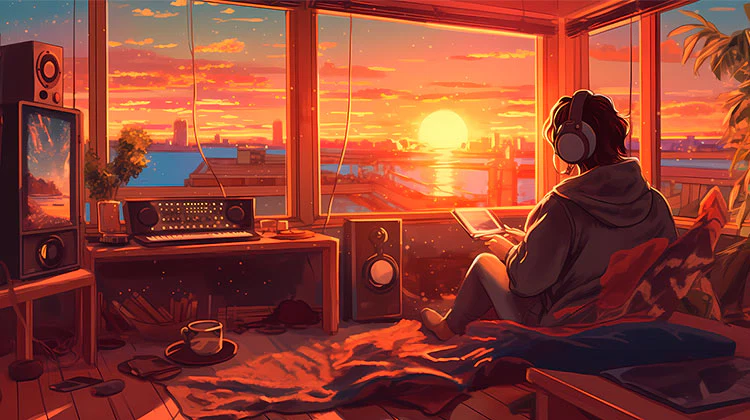
Rainy windows. Warm lamps. Headphones. Bedrooms. Books. Cats. Nighttime city views. Coffee. Autumn colors.
None of these elements is inherently musical.
Together, though, they communicate a mood before the first snare arrives.
The original stream had actually used footage derived from Studio Ghibli's Whisper of the Heart, which led to a copyright-related takedown in 2017. The channel subsequently moved toward an original animated character, eventually developing the identity now associated with Lofi Girl.
That early copyright problem also illustrates an important reality of internet music culture: visual branding and music distribution have legal consequences just as real as those surrounding traditional releases.
From underground beatmaking to a production template
Once lo-fi became popular, its sound became easier to describe.
A typical modern lo-fi hip-hop production might use:
A tempo somewhere around 70–90 BPM
Soft or heavily processed drums
Swing or deliberately imperfect timing
Warm electric piano, guitar, or jazz-derived harmony
Low-pass filtering and saturation
Vinyl or tape-style noise
Short melodic loops
Subtle ambience such as rain, room tone, or environmental recordings
But these aren't laws.
A track can run at 65 BPM and still work. Another can sit at 95 BPM. Some producers use pristine digital recordings and only imitate analog imperfections with plugins.
That's an important evolution: lo-fi is increasingly a production aesthetic rather than a literal measure of recording fidelity.
You can make a 24-bit/96 kHz recording that sounds deliberately lo-fi.
The irony isn't accidental.
Chillhop helped turn the scene into an ecosystem
Labels and independent platforms helped move lo-fi from anonymous uploads toward a sustainable artist ecosystem.
Chillhop Records, founded in Rotterdam in 2015, is a useful example. Its early model grew through free downloads and compilations before developing into a label with recurring releases and recognizable artists. Bandcamp's profile of the label describes how its early compilations brought together artists working under overlapping labels such as jazz-hop, jazz hip-hop, and lo-fi hip-hop.
That structure mattered.
Instead of asking listeners to discover one producer at a time, compilations created a shared sonic identity. Listeners could follow the scene.
Streaming platforms accelerated the process.
Today, Spotify contains enormous quantities of lo-fi releases and playlists, ranging from dedicated artist projects to study, sleep, reading, gaming, and mood-focused collections. Even a Spotify artist page for an act literally named “LO-FI BEATS” shows tens of thousands of monthly listeners and multiple releases spanning 2021–2025.
The underground didn't disappear.
It multiplied.
The global phenomenon is really about utility
This may be the biggest reason lo-fi survived its novelty phase.
People found uses for it.
A student needs something without lyrics. A programmer wants steady background sound. Someone working from home wants atmosphere without dramatic changes. A gamer wants music that fills silence without competing with dialogue.
Lo-fi fits all of those situations.
The music's repetitive structure is an advantage. A two-minute loop can repeat without demanding attention in the way a conventional pop chorus might.
That's why “study beats” became such a powerful search concept.
The listener isn't necessarily buying into a genre identity. They are solving a problem.
They need sound that stays out of the way.
YouTube's own reporting on Lofi Girl documented how the channel evolved into a major cultural phenomenon, with the stream approaching one billion views by 2021.
And YouTube's broader 2025 Culture & Trends reporting makes the larger shift clear: creators now operate inside a global, participatory ecosystem in which audiences don't merely consume content but actively extend it through their own communities and creations.
Lo-fi was unusually well suited to that environment.
What producers can learn from the lo-fi evolution
There's a practical lesson buried underneath all the nostalgia.
Don't confuse imperfection with carelessness.
If you're producing a lo-fi beat in Ableton Live, FL Studio, Logic Pro, or another DAW, randomly degrading every channel won't automatically produce character. The better approach is selective.
Try nudging a few drum hits away from the grid rather than moving everything. Filter a sampled chord progression before adding saturation. Automate subtle volume changes. Resample a phrase, then chop the resampled version.
And listen before adding more plugins.
A surprisingly common beginner mistake is stacking vinyl noise, tape saturation, bit reduction, chorus, reverb, and low-pass filtering until the original musical idea is buried.
One texture may be enough.
Another useful experiment is to build the beat around a short loop and resist the urge to over-arrange it. Let a four- or eight-bar idea breathe. Change one element after several repetitions. The ear notices small movement when the foundation remains stable.
That's part of why the best lo-fi beats can feel almost effortless.
They aren't.
Where lo-fi goes next
Lo-fi has already escaped its original boundaries.
There is lo-fi jazz, lo-fi pop, lo-fi soul, ambient lo-fi, piano lo-fi, game-inspired lo-fi, electronic lo-fi, and countless hybrid forms. Producers increasingly combine the aesthetic with modern synthesis, field recording, granular processing, guitar pedals, modular systems, and sophisticated mastering chains.
The technology keeps getting cleaner.
The taste doesn't necessarily follow.
That tension could define the next stage of the genre. AI-assisted production, increasingly powerful DAWs, spatial audio, short-form video, livestream culture, and algorithmic discovery are all changing how music gets made and heard. Yet lo-fi's central appeal remains stubbornly human: repetition, restraint, texture, and the sensation that somebody made this beat in a room somewhere.
Perhaps that's why the genre continues to work.
It doesn't demand perfection.
It asks for presence.
Frequently Asked Questions About Lo-Fi
What does “lo-fi” actually mean?
Lo-fi means “low fidelity,” originally referring to recording or production with audible imperfections or technical limitations. Modern lo-fi music often uses those imperfections intentionally as an aesthetic choice.
Is lo-fi hip-hop the same as chillhop?
Not exactly. The terms overlap heavily, but they aren't perfect synonyms. Chillhop can describe a broader blend of hip-hop, jazz, soul, and downtempo influences, while lo-fi hip-hop usually emphasizes mellow beats, sampling, texture, and deliberately imperfect production.
Why is lo-fi music so popular for studying?
Its repetitive arrangements, moderate tempos, instrumental focus, and relatively restrained dynamics make it suitable as background music. The listener can keep the music running without constantly shifting attention toward lyrics or dramatic structural changes.
What equipment do you need to make lo-fi beats?
A modern DAW is enough. You don't need vintage hardware. Software samplers, drum machines, saturation, filtering, reverb, and manual timing adjustments can reproduce many of the techniques associated with classic lo-fi production. Hardware such as the Roland SP-404 can add a different tactile workflow, but it's optional.
Who are the most influential artists in lo-fi's history?
The answer depends on where you draw the genre's boundaries, but J Dilla and Nujabes are two essential reference points for modern lo-fi hip-hop. Later artists, labels, YouTube channels, and beat communities expanded those ideas into the recognizable global lo-fi culture of the 2010s and 2020s.
The next beat is probably less “lo-fi” than you think
The funny thing about lo-fi's success is that it didn't become globally popular by becoming technically perfect.
It did the opposite.
Producers took hiss, timing imperfections, chopped samples, muted drums, dusty textures, and tiny melodic loops and made those limitations feel intentional. Then YouTube gave the sound a visual home, streaming gave it infinite shelf space, and listeners gave it a job.
Study with it.
Work with it.
Sleep with it.
Make something with it.
For producers, the useful next step isn't copying the familiar vinyl-crackle formula. Start with the older idea underneath it: take a limitation, exaggerate it just enough to become expressive, and build the music around the character that appears.
That's where the evolution of lo-fi really continues.
lo-fi music
lo-fi evolution
underground music culture
global lo-fi trend
chill beats
Found this helpful? Share it!