
How to Read Sheet Music Easily – Beginner Guide
413 views
You can know what a treble clef is and still stare at a page of music thinking, “Okay… where do I actually start?”
That’s the annoying part.
Reading sheet music isn't really about memorizing dozens of symbols at once. It’s about learning to scan a page in the right order: identify the musical map, locate the notes, recognize the rhythm, spot patterns, and only then play. Once that sequence becomes automatic, the page stops looking like a collection of random dots.
This guide takes that practical approach. Instead of rehashing isolated lessons about note names, chords, or time signatures, we’ll focus on how to turn notation into something you can actually read at the instrument.
First, stop trying to read everything at once
A beginner often makes the same mistake: looking at a note and immediately asking, “What note is that?”
That sounds sensible. It isn't always efficient.
A piece of sheet music gives you several kinds of information simultaneously. Pitch is arranged vertically, while rhythm moves horizontally through time. Yamaha describes this same division when explaining how pitch is represented on the staff and how rhythmic information is organized across measures.
Think of the page as a map.
Before playing the first note, quickly check:
Clef: Which register are you reading?
Key signature: Which notes are regularly sharp or flat?
Time signature: How is the beat organized?
Tempo: How fast should the music move?
Dynamics: Is it soft, loud, or changing?
Articulation: Are notes smooth, detached, accented, or held?
Repeats: Do you actually need to read every measure once?
That ten-second scan prevents a surprising number of mistakes.
And it gets easier with repetition.
The staff is your musical coordinate system
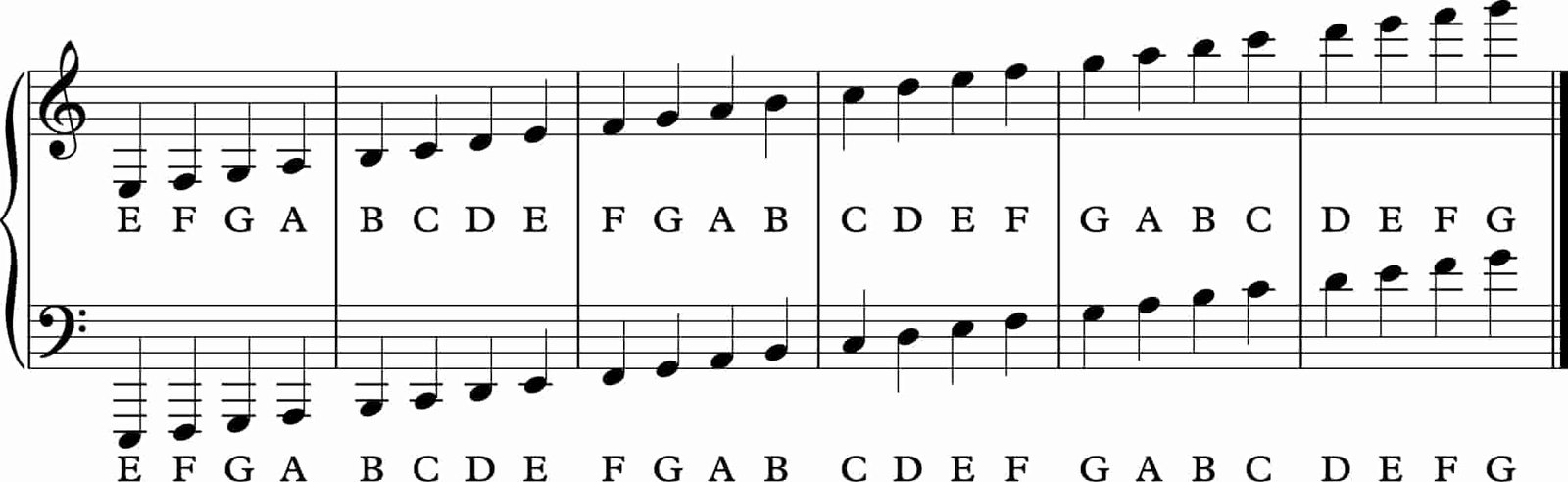
The five horizontal lines are the staff. Notes sit on lines or in spaces, and their vertical position tells you about pitch.
For beginners, the two clefs you'll encounter most often are treble clef and bass clef.
Treble clef generally covers higher-pitched material. Bass clef handles lower material. On piano, they're normally combined into the grand staff, with the right hand commonly reading treble and the left hand commonly reading bass.
The key landmark is middle C.
On a grand staff, middle C sits between the treble and bass staves. Once you can locate that one note reliably, you have a reference point from which other notes become much easier to understand.
Don't try to memorize every note on the page in one sitting.
Instead, learn a few reference notes and recognize the distance between them.
For example, if you know a note is C and the next note moves one staff position upward, you've moved to D. Two positions gives you E. You're beginning to read relationships rather than isolated symbols.
That distinction matters.
ABRSM's Grade 1 theory syllabus treats the staff, treble and bass clefs, note names, middle C, accidentals, and basic note values as foundational reading skills.
Read by patterns, not by individual letters
Here's where sheet music starts becoming much easier.
Suppose you see four notes moving upward step by step.
You don't necessarily need to think:
C… D… E… F.
You can recognize the visual pattern: four consecutive notes rising.
That becomes even more useful with intervals.
A melody might jump from C to G, then descend to E. Instead of calculating every letter from scratch, your eyes eventually recognize the shapes and distances.
This is how experienced sight-readers appear to “read ahead.” They're not magically naming every note faster. They're recognizing familiar structures.
Look for:
Stepwise motion
Repeated notes
Repeated rhythmic cells
Scales
Arpeggios
Chord shapes
Sequences
Repeated measures
Melodic fragments
A four-bar phrase might contain only two genuinely new ideas. The rest could be repetition with a small variation.
Spotting that saves mental energy.
Rhythm deserves its own attention
Pitch gets most of the attention from beginners, but rhythm is where a lot of otherwise correct playing falls apart.
A note tells you what to play. Its duration tells you how long to play it.
The time signature provides the framework. In a 4/4 measure, for example, four quarter-note beats fit into the bar. In 3/4, there are three quarter-note beats. The upper number tells you how many beats are grouped into a measure, while the lower number indicates the note value assigned to each beat.
Don't just count silently in your head.
Try saying:
1 — 2 — 3 — 4
Then subdivide:
1-and-2-and-3-and-4-and
For faster rhythms, go further:
1-e-and-a 2-e-and-a
It may feel ridiculously slow at first. That's fine.
If the rhythm isn't stable at 50 BPM, playing it at 100 BPM won't magically fix it.
The notes will simply become wrong faster.
Melody Beats already covers rhythm and time signatures as standalone theory topics; the useful next step here is applying those concepts while your eyes move across an actual score.
Learn key signatures as shortcuts
A key signature can look intimidating because those sharps or flats sit there for the entire piece.
Treat them as a shortcut instead.
If you see one sharp in the key signature, that's F-sharp. You don't need to rediscover that fact every time an F appears.
The same principle applies to flats.
Then watch for accidentals. A sharp, flat, or natural placed beside a note can temporarily alter what you'd expect from the key signature.
This is one reason beginners sometimes play a piece correctly for several measures and suddenly hit one painfully wrong note. They learned the key signature but stopped watching the measure itself.
Keep your eyes slightly ahead of your hands.
That's a habit worth developing early.
Don't confuse note recognition with sight-reading
Knowing that the note on a particular line is E is one skill.
Reading an unfamiliar eight-bar melody without stopping every two seconds is another.
That's sight-reading.
The difference is similar to knowing vocabulary versus reading a sentence fluently. You need the individual pieces, but fluency comes from processing them together.
A useful beginner exercise looks like this:
Pick a very easy piece you've never played.
Identify the clef, key signature, and time signature.
Tap or count the rhythm without playing.
Find the starting note and hand position.
Look through the first phrase for repeated patterns.
Play slowly without stopping for mistakes.
Repeat it while gradually increasing the tempo.
The key instruction is hidden in step six: don't stop.
If you miss a note during sight-reading practice, keep the pulse moving. Stopping every time you make an error trains your brain to stop.
That's the opposite of what you're trying to build.
ABRSM's Piano Sight-Reading Trainer takes a similar pattern-focused approach, using exercises designed to help learners quickly identify key features and patterns before playing; its current program covers Grades 1–5 and includes 155 pieces.
Use technology as a second set of ears
Digital sheet music can make practice dramatically more convenient, provided you don't let playback do all the thinking.
Musicnotes offers apps for iOS, Android, Mac, and PC with features including playback, looping, tempo adjustment, annotation, and transposition. Its catalog currently lists more than 500,000 arrangements.
Here's a useful workflow:
Read first. Listen second. Play third.
If you immediately press play and copy what you hear, you're practicing imitation rather than reading.
Instead, attempt a short passage yourself. Then listen. Did the rhythm match? Was the pitch wrong? Did you overlook an accidental?
That's much more informative.
Musicnotes also supports transposition for eligible arrangements, although not every arrangement can be transposed; its documentation specifically excludes some categories such as certain Guitar TAB, virtuosic, and Marketplace arrangements.
That limitation is worth knowing before you buy a score expecting a one-click key change.
MuseScore is useful for seeing music from the other side
If you're learning notation, creating a score can be surprisingly helpful.
MuseScore Studio is a practical option because you're not only reading notation — you're entering it, editing it, and hearing the result.
MuseScore Studio 4.6, released in September 2025, added improvements including real-time note preview with duration and velocity control, better playback, a chord-symbol overhaul, support for SMuFL-compliant music fonts, and VST3 support on Linux.
Try entering a four-measure melody yourself.
Then change one thing.
Make a quarter note into two eighth notes. Move a pitch upward. Add a rest. Play it back.
Suddenly notation stops being abstract. You're seeing exactly how a written change affects the music.
That's powerful practice.
A simple 15-minute reading routine
You don't need an hour-long theory session every day.
Try this instead.
Minutes 1–3: Choose a new, easy score. Identify the clef, key, meter, tempo, dynamics, and repeats.
Minutes 4–6: Clap or tap the rhythm. Don't touch the instrument yet.
Minutes 7–11: Sight-read slowly. Keep the beat moving, even when you make mistakes.
Minutes 12–15: Replay the difficult measures, isolate the problem, and try them again.
Then stop.
Short, focused practice beats repeatedly grinding through a piece you already know.
If you're learning piano, use separate hands initially when necessary, but don't stay there forever. Eventually, the real skill is coordinating both staves while maintaining a steady pulse.
What beginners usually get wrong
Memorizing mnemonics forever
“Every Good Boy Does Fine” can help you start. So can “FACE.”
But if you're still reciting the entire mnemonic internally for every note months later, it's slowing you down.
Use mnemonics as training wheels. Move toward instant recognition.
Looking only at your hands
This is especially tempting on piano.
You hit a note, glance down, look back up, and suddenly you've lost your place.
Practice keeping your eyes on the score for longer stretches. Peripheral vision can handle more than you think.
Playing too fast
Speed hides understanding.
A slow, accurate reading gives your brain enough time to process pitch, rhythm, fingering, and expression simultaneously.
There's no prize for playing a beginner piece at 120 BPM while guessing half the notes.
Ignoring rests
A rest isn't empty space.
It has duration.
Treat it as part of the rhythm, not as a moment where nothing happens. That small mental shift makes ensemble playing much more reliable.
FAQ: Reading Sheet Music for Beginners
How long does it take to learn to read sheet music?
Basic note and rhythm recognition can develop within a few weeks of consistent practice. Comfortable sight-reading takes longer because it depends on pattern recognition, rhythm control, and instrument technique.
Ten to fifteen focused minutes a day is a perfectly respectable starting point.
Should I learn treble or bass clef first?
If you're playing piano, learn both, but give treble clef a little more initial attention if your beginner repertoire emphasizes the right hand. Learn bass clef soon afterward rather than treating it as an advanced topic.
Is it better to memorize note names or intervals?
Both matter, but intervals and visual patterns become increasingly valuable for fluent reading. Note names give you the foundation; interval recognition helps you stop decoding every note from scratch.
Should I use an app that plays the music?
Yes — as a supplement.
Try reading the passage yourself first, then use playback to check your interpretation. Apps such as Musicnotes can slow playback, loop sections, annotate scores, and transpose eligible arrangements, making them useful practice companions rather than replacements for reading.
What's the fastest way to improve?
Read unfamiliar, easy music every day.
Not difficult music. Easy music you haven't seen before.
Your goal is to train the eyes and brain to keep moving through notation without panic. A handful of simple pieces read consistently will usually teach that skill better than repeatedly memorizing one challenging song.
Your next page should be easier
The trick isn't learning sheet music as one giant subject.
Break the page into layers: map first, pitch second, rhythm third, patterns fourth, performance last.
After a while, those steps start happening almost simultaneously. The staff becomes familiar. Key signatures stop looking threatening. Rhythms become shapes instead of puzzles. And eventually you'll glance at a new passage and have a rough sense of how it sounds before your fingers even move.
That's the point to aim for.
Pick an unfamiliar piece today. Keep it comfortably below your playing level, give yourself 15 minutes, and read it without stopping.
Next week, do the same thing with a slightly harder page.
That's how sheet music starts looking less like a code — and more like music.
sheet music for beginners
how to read sheet music
music notes guide
beginner music reading
reading music basics
Found this helpful? Share it!