
What Are Chords? Beginner Music Theory Guide
388 views
You can play the right notes and still have no idea why a song sounds good.
That’s one of the first frustrations beginners run into with music theory. You learn scales. You memorize a few piano or guitar shapes. Then somebody says, “That’s a dominant seventh,” and suddenly the simple act of pressing three or four notes feels like a university lecture.
It doesn't have to.
A chord is simply a group of notes heard together as a harmonic unit. But that basic definition only gets you halfway there. To really understand chords, you need to see how roots, intervals, scales, chord qualities, inversions, and progressions fit together.
This guide takes that next step. Rather than treating chords as isolated shapes to memorize, we'll look at what's happening underneath them—and how you can use that knowledge when playing, writing, arranging, or producing music.
So, what actually makes a chord?
At the simplest level, a chord contains multiple pitches sounding together. Two notes can form a harmonic interval, while a conventional chord in tonal music typically contains three or more distinct notes.
The most useful beginner example is the triad.
Take C major:
C – E – G
C is the root. E is the third. G is the fifth.
Those labels describe each note's relationship to the root, not necessarily its position on your instrument. That distinction matters later, especially when you start using inversions.
A Yamaha instructional reference describes C–E–G as a triad and identifies the root as the note that anchors the chord.
Here's the part beginners often miss: a chord isn't defined by its shape. It's defined by its notes and their relationships.
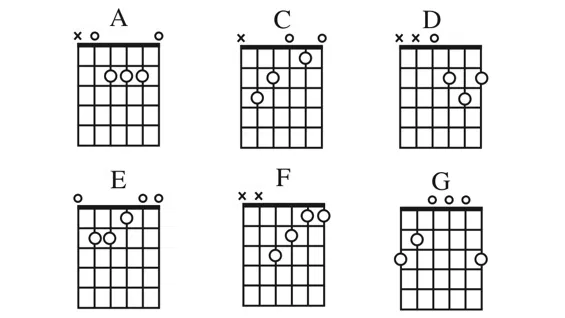
On a piano, C–E–G might be three adjacent white keys with one key skipped between each chord tone. On guitar, the same chord could involve several strings, duplicated notes, and a completely different physical shape.
Same harmony. Different geography.
The secret ingredient is the interval
If chords seem mysterious, intervals are usually the missing piece.
An interval measures the distance between two pitches. For chord construction, you'll frequently encounter measurements in semitones, also called half steps.
A major third is four semitones above the root.
A minor third is three semitones above it.
That one-semitone difference creates a major portion of the familiar major/minor contrast.
Major triad
A major triad uses:
Root + major 3rd + perfect 5th
For C major:
C – E – G
Minor triad
A minor triad uses:
Root + minor 3rd + perfect 5th
For C minor:
C – E♭ – G
Notice what changed.
Only E moved down one semitone to E♭, yet the character of the chord changes substantially. Yamaha's chord explanation likewise distinguishes major and minor thirds by their four- and three-semitone distances from the root.
That tiny movement is worth practicing by ear. Play C–E–G, then C–E♭–G. Don't analyze it immediately. Listen first.
Theory sticks better when your ears recognize what your eyes are reading.
Why triads are such a big deal
Triads aren't merely the “easy chords” you learn before the real stuff.
They're foundational.
Major, minor, diminished, and augmented triads provide the structural core for a huge amount of tonal harmony. Formal music-theory curricula commonly introduce triads before moving into seventh chords, inversions, voice leading, and more complex harmonic functions. Berklee's Music Theory 101 sequence follows essentially that progression.
The four basic triad qualities are:
Triad type | Formula | Example from C |
|---|---|---|
Major | 1–3–5 | C–E–G |
Minor | 1–♭3–5 | C–E♭–G |
Diminished | 1–♭3–♭5 | C–E♭–G♭ |
Augmented | 1–3–♯5 | C–E–G♯ |
Don't rush to memorize every formula.
Instead, build them.
Start on C. Find the third. Find the fifth. Alter one note. Hear what happens.
That process is far more useful than memorizing dozens of chord diagrams without understanding what you're actually playing.
Chords come from scales
Here's where chord theory starts connecting to the rest of music theory.
Suppose you're working in C major:
C D E F G A B
If you build a triad by stacking every other scale note, you get:
C–E–G
D–F–A
E–G–B
F–A–C
G–B–D
A–C–E
B–D–F
These are the diatonic triads of C major.
Their qualities are:
Major – minor – minor – Major – Major – minor – diminished
In Roman-numeral analysis, that becomes:
I – ii – iii – IV – V – vi – vii°
This is one of the most useful patterns a beginner can learn because it works beyond C major. Move the pattern into another major key and the relationships remain the same.
For example, in G major, the notes change because the scale contains F♯, but the chord-quality pattern remains:
I major, ii minor, iii minor, IV major, V major, vi minor, vii° diminished.
That's the difference between memorizing chords and understanding harmony.
Chord progressions are where things get musical
A single chord has a character.
A progression gives that character somewhere to go.
Try this in C major:
C – G – Am – F
Or, using Roman numerals:
I – V – vi – IV
You've probably heard this general harmonic pattern in countless pop, rock, worship, folk, and singer-songwriter settings.
The interesting part isn't just that the chords sound pleasant individually. Their sequence creates expectation and release.
This is why chord theory becomes much more useful once you stop asking, “What chord is this?” and start asking, “What is this chord doing here?”
A V chord, for example, often creates a strong pull toward I. That relationship between dominant and tonic is one of the central ideas in tonal harmony. More advanced harmony courses explicitly study chord function, cadences, and progression patterns such as ii–V–I.
You don't need to master functional harmony on day one.
But start listening for it.
Chord symbols are a shorthand language
When you see C, you're generally looking at a C major chord.
Cm means C minor.
C7 means C dominant seventh.
Cmaj7 means C major seventh.
Csus4 indicates a suspended fourth.
The symbol tells the player what harmonic structure to realize, but it doesn't always dictate one exact voicing.
That's a subtle distinction—and an important one.
For example, C major can be played:
C–E–G
or
E–G–C
or
G–C–E
Those are different arrangements of the same three chord tones.
They're called inversions.
Root position isn't the only position
If the root is the lowest note, a triad is in root position.
For C major:
C–E–G
Move C above E and G:
E–G–C
That's first inversion.
Move E above the others:
G–C–E
That's second inversion.
The chord hasn't magically become a different chord. C major is still C major.
What changes is the bass note and the spacing.
This becomes especially useful on piano and guitar because inversions can make chord changes much smoother. Instead of jumping your entire hand across the instrument, you can choose nearby notes and let individual voices move only a short distance.
That technique is called voice leading. Berklee's guidance on voice leading emphasizes keeping common tones where possible and moving other voices by small intervals.
In practice, this can make a progression sound noticeably more polished without adding a single new chord.
What about seventh chords?
Once triads feel comfortable, add a fourth chord tone.
For example:
C–E–G–B
That's Cmaj7, a C major seventh chord.
Another common sound is:
G–B–D–F
That's G7, a dominant seventh chord.
Seventh chords appear everywhere—from jazz and soul to R&B, pop, gospel, blues, film music, and contemporary songwriting. Berklee's foundational theory sequence introduces major seventh, dominant seventh, minor seventh, and diminished seventh structures after basic triads.
Don't memorize them as strange four-note shapes.
Think of them as extensions of the triad.
C major gives you C–E–G.
Add B.
Now you have Cmaj7.
That mental model scales much better.
Why a chord can sound different on piano and guitar
Here's a common beginner trap: assuming every note in a chord must appear exactly once.
Not so.
A guitar player might play several versions of C major containing duplicated C or G notes. A pianist might spread the chord across two octaves. A producer working in a DAW might place the bass note separately and use only the upper chord tones in a MIDI voicing.
The harmonic identity can survive all of that.
Berklee's piano-voicing material specifically distinguishes chord tones from the way those tones are arranged, and its guidance discusses using roots, chord tones, and different voicings to produce practical harmonic textures.
So don't get trapped by diagrams.
Learn the notes.
Then learn the shapes.
A practical 10-minute chord exercise
You can do this on a piano, keyboard, guitar, or MIDI keyboard.
1. Build four C triads.
Play:
C–E–G
C–E♭–G
C–E♭–G♭
C–E–G♯
Listen carefully to the difference between each quality.
2. Move into a progression.
Try:
C → Am → F → G
Play each chord slowly. Then repeat the progression without looking at your hands.
After a few repetitions, change the voicing so that the notes move as little as possible.
That's the beginning of voice leading.
And it's where theory stops feeling like vocabulary homework.
Common beginner mistakes
Memorizing shapes without knowing the notes
This works until somebody asks you to play the same chord in a different position.
Learn both: the physical shape and the chord's ingredients.
Assuming “major = happy” and “minor = sad”
Major and minor qualities do have recognizable tendencies, but musical emotion isn't a fixed dictionary.
Tempo, melody, instrumentation, rhythm, register, lyrics, context, and voicing all matter.
A slow major chord can sound heartbreaking. A fast minor progression can sound energetic.
Adding complicated chords too early
A beginner doesn't need twenty-seven exotic voicings.
Get fluent with major and minor triads first. Then learn diminished, augmented, suspended, and seventh chords as they become musically useful.
That progression mirrors the way foundational harmony is commonly taught.
FAQs about chords
How many notes do you need to make a chord?
There isn't one universal minimum definition across every musical context, but three-note triads are the fundamental starting point for conventional chord theory. Two simultaneous notes are generally better described as an interval or dyad.
What is the difference between a chord and a chord progression?
A chord is one harmonic structure. A chord progression is a sequence of chords.
C–G–Am–F is a progression containing four chords.
Do chords have to be played all at once?
No. Chord tones can be distributed across instruments or separated in time depending on the musical context. A bass can play the root while a keyboard or guitar supplies the remaining chord tones.
Should I learn chords on piano or guitar first?
Use whichever instrument you'll actually practice. Piano makes note relationships visually obvious, while guitar makes movable shapes and voicings highly practical. The underlying theory is the same.
What should I learn after basic triads?
Learn inversions and seventh chords next. Then explore chord progressions, harmonic function, voice leading, and chord extensions. That sequence gives you a much stronger foundation than simply collecting more chord shapes.
Your next step: build chords instead of memorizing them
The fastest way to make chords feel less mysterious is to stop treating them as isolated objects.
Pick one key.
Build its scale. Stack thirds. Identify the triads. Play their inversions. Listen to how one chord moves into the next.
Then do it again in another key.
After a while, C–E–G won't just look like three notes on a page. You'll hear the major third, recognize the fifth, understand why the chord is called C major, and know how it can move into the next harmony.
That's the real payoff of learning chords: not knowing more names, but hearing more of what music is doing.
Try one progression today. Play it slowly. Change the voicings. Listen closely.
Then build another.
music chords
beginner music theory
chord basics
how chords work
learning chords
Found this helpful? Share it!